
This is how the three variants of SURF Time&Frequency work via the SURF network.
SURF Time&Frequency
Accurate and stable time and frequency signals via the SURF network
SURF Time&Frequency delivers time and frequency signals at various levels of precision via the SURF network. This enables research institutions to carry out experiments where precision synchronisation is crucial, without relying on GPS.

Advantages
Very high precision
Time and frequency signals at three different precision levels, with time stamping accurate to below one nanosecond.
Alternative to GPS
Reliable operation in environments where satellite signals are limited or disrupted.
Consistent synchronisation
One uniform time source for perfect alignment between systems and locations.
Do you have a question about SURF Time&Frequency? Get in touch.

Sander Klemann
E-mail
Time&Frequency explained
What is SURF Time&Frequency?
SURF Time&Frequency is a specialised service for research and education institutions, delivering accurate and precise time and frequency signals. It guarantees that multiple systems share a common reference, based on a traceable source and time. The service is distributed via fibre optic connections to institutions connected to the SURF network. It consists of two components:
- A time signal, which indicates the time very precisely as a timing pulse.
- A frequency signal, which measures how many times an event repeats or a wave occurs per second, expressed in Hertz.
Want to know more about Time&Frequency? Visit the wiki (in Dutch).
SURF Time&Frequency offers 3 different levels of synchronisation services, tailored to different needs:
1. Network Time Protocol (NTP)
The standard level of synchronisation, measured in milliseconds, available through the SURF network. Would you like to use this signal? Please contact us.
2. Precision Time Procol (PTP)
High level of precision, measured in microseconds and suitable for hardware-based time stamping. This allows a major step forward in synchronisation capabilities, such as achieving perfect synchronisation in media streaming. Currently, PTP is still under development and not available through the SURF network.
3. White Rabbit
White Rabbit is intended for scientists and research centres that require highly accurate time and frequency signals to make their research data as truthful as possible. It offers synchronisation with an accuracy of less than 1 nanosecond and a precision in the picosecond range. It is designed for large, distributed systems in which devices are connected via a network.
Reference signal from the VSL atomic clock
White Rabbit uses a reference signal originating from the National Metrology Institute VSL in Delft. Using 4 atomic clocks, VSL realises Coordinated Universal Time (UTC) for the Netherlands. The time and frequency signals are delivered via the fibre optic infrastructure of the SURF network. These signals are available at all times and everywhere, without disruption or interruption.
White Rabbit Collaboration
The White Rabbit technology was developed by the White Rabbit Collaboration and is used worldwide in various research and institutes. Read more about the collaboration and developments in the White Rabbit Collaboration here.
The Dutch Time&Frequency network for research and education
By the end of 2025, the White Rabbit signal will be available at 11 locations in the Netherlands. At these locations, the signal is distributed by dedicated White Rabbit switches built into several local networks of universities and research groups. Together, these 11 locations form the Dutch Time&Frequency network for research and education. The network is expected to expand further in the coming years.

The Dutch Time&Frequency network is available in Amsterdam, Delft, Den Bosch, Dwingeloo, Eindhoven, Enschede, Groningen, Leiden, Utrecht, Zwolle and Maasland.
Multiple Time&Frequency networks in the Netherlands
In addition to the Dutch Time&Frequency network for research and education, work is also underway on 2 other Time&Frequency networks. These networks respond to the need for highly accurate time and frequency signals over fibre optics among other groups in the Netherlands. In the long term, this may result in the following 3 networks, aligned with the needs of these groups:
- The Dutch Time&Frequency network for research and education, as part of the SURF network and only available to organisations connected to the SURF network.
- A national Time&Frequency network for government and semi-government institutions. Several initiatives for this are underway at government level.
- A Time&Frequency network for industry. Various commercial parties are investigating the possibilities for this.
More about Time&Frequency
-
When exactly is a second over? And how accurate is the time on your smartwatch, laptop or phone? And most importantly, what does it really matter, precise and accurate time and location tracking?

-
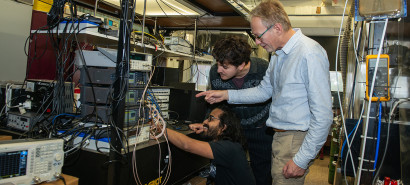
SURF Time&Frequency gives researchers access to unprecedented measurement precision via fibre. University lecturer Jeroen Koelemeij, for instance, uses the service to measure atomic vibrations to twelve decimal places. The technology is also being investigated as a safer alternative to GPS. Read how it works in this real-life story.
 Case study
 -
SURF, together with the White Rabbit Collaboration and the Dutch Metrology Institute VSL, has realised the first nationwide scientific time and frequency network in the Netherlands. VSL’s highly…
 News
News


Rates
View the tariffs of this service.
SURF Diensten en Tarieven 2027
View the tariffs of this service.
SURF Diensten en Tarieven 2027