
2023
These are the winners of the SURF Research Support Awards 2023.
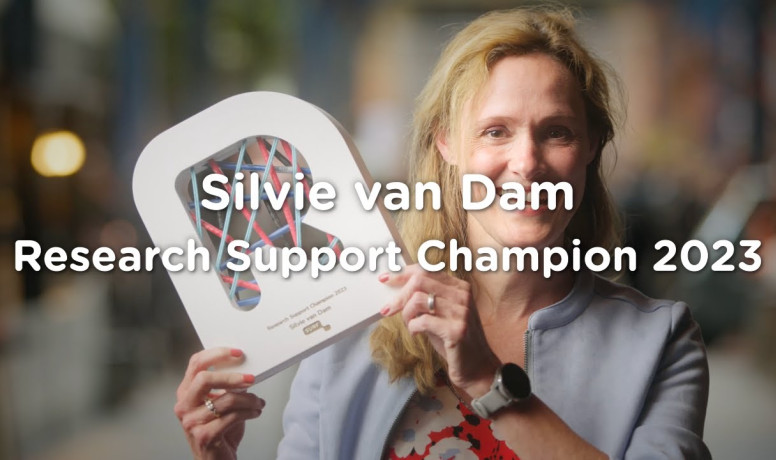
Silvie van Dam
Silvie van Dam is manager Research Development and Support Office and Senior Research Policy Advisor at Eindhoven University of Technology (TU/e). Among other things, her proactive attitude and talent for thinking in solutions won her one of the SURF Research Support Champion Awards 2023.

Service-oriented
Within research support at TU/e's Faculty of Architecture, Silvie knows how to connect everyone: scientists, management, IT advisors, but also departments such as legal affairs and HRM. She knows a lot of people and can put herself in many different worlds. This is important because the Faculty of Architecture has a large number of different disciplines, from civil engineering to architecture, from human behavioural research to artificial intelligence. These all have their own needs for support. Serving all these different people and disciplines well is quite a challenge, but Silvie seems to succeed effortlessly. This is partly because she is truly service-oriented: she sees solutions where others see problems.
Pro-active and future-oriented
Another special feature is that Silvie is very knowledgeable about content. She is involved in choices about research at all levels: from the government, TU/e and the faculty. She then knows how to assess what these choices will mean for research and researchers, and she initiates the processes that anticipate this. In this, she is very proactive and future-oriented.
Team expanded
It is also great to see how Silvie has expanded her Research Development and Support Office team. The team initially consisted of three employees, but is now so well liked that Silvie has expanded it to no less than eight people within a year. A handsome achievement. Her team has one top priority: excellent support. With her humour, sense of proportion and open attitude, she gets the best out of her people so that they can actually provide that excellent support.
PhD network
Silvie also plays an active role in TU/e's PhD network, where young researchers are updated on the latest developments such as open science, FAIR data, privacy and security, lab technicians, the ethical and medical review board.
What does the jury say about Silvie?
Silvie is a true supporter. She is a connector who thinks along and does a lot of work behind the scenes. She knows how to connect people and groups.
This is exactly the kind of work that has impact but often goes unnoticed because it does not lead to direct 'output'. However, it is precisely incredibly important work, which we want to reward through this award.
As a jury, we also find impressive the way Silvie guides faculties within TU/e that want to store data according to the FAIR principles. These are principles for making digital assets more findable, accessible, interoperable and reusable. It is now a widely applied guideline framework for data management.
How does Silvie hope to inspire others?

Silvie: "Being able to connect people, processes and policies is very important. It is primarily about the people, in my case the researchers. They must be able to do their work well, and good processes and policies must serve that purpose.
So it starts with a genuine interest in what people need. So that you also find out, for instance, that something no longer works when policies change. Then you have to come up with a workaround together with the researcher, so that she can do her job properly and still be compliant with policy and legislation.
My tip: truly form a team together with the researcher, so you can come up with the best solution together."
What do colleagues say about Susan?

Training in research integrity
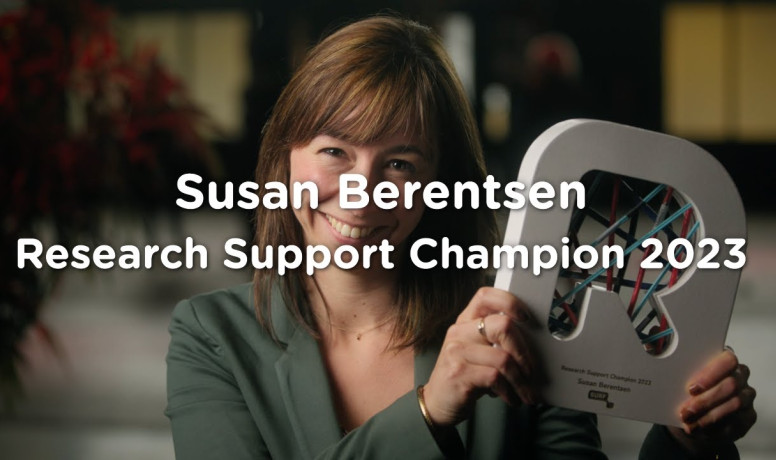
Susan researches and gives training courses on research integrity. She wants to make the importance of research integrity a subject of discussion, while working towards shared norms and values for conducting good research. Susan is co-developer of the TETRIAS training (www.tetrias.eu) for teacher-researchers and research teams.
Having a conversation
Having the conversation about dilemmas surrounding research integrity is a focus of Susan's training courses. For example, how do you recognise that integrity is coming under pressure? Susan gives training participants tools to deal with such dilemmas. This motivates her trainees to take care of the quality and transparency of their research, which in turn contributes to the way they handle their data.
Not the easy way out
What is special is that Susan addresses research integrity in the college setting, where research integrity has not been such a visible topic until now. So she does not choose the easy path, even if it sometimes takes more time and energy.
Making practical what seems abstract
Through her drive and enthusiasm, Susan actually makes the concept of research integrity, which initially sounds rather abstract to many students and teachers, practical and manageable. This puts the concept on the map within HAN, but also beyond, in discussions with ethics committees and lecturers at other universities of applied sciences. Through the appealing format of her training courses, she motivates colleagues to embrace the subject and pass on the knowledge and skills they have gained to their colleagues and students themselves.
Because she is so motivated to spread the subject, Susan delivers her TETRIAS training courses on research integrity at six different colleges. So she looks beyond her own institution. This also manifests itself through the publication of a paper on setting up a training course on research integrity, with a detailed roadmap. The aim of this is to also help others design high-quality training courses that fit the target group.
International
And Susan's work is now also being seen internationally. At the European H2020 project Path2Integrity, for instance, a presentation was made on the TETRIAS training.
What does the jury say about Susan?
Susan has a great impact on the people she speaks to and to whom she provides training. She is communicative and takes an active role in supporting researchers. Her role as an ambassador for research integrity is impressive. She is also making headway internationally in this field.
The jury is also impressed by Susan's activities with the Netherlands Research Integrity Network (NRIN) and the Network for Education and Research Quality (NERQ). In these networks, Susan shares her knowledge and experience on research integrity across Europe.
How does Susan hope to inspire others?

Susan: "The most important quality of a research supporter is passion, intrinsic motivation for your work. I myself am enthusiastic about research integrity, and that drive allows me to raise awareness of the topic more widely.
My tip: drink lots of coffee with people. Because I would not be able to spread the subject of research integrity on my own. Originally, I'm used to working energetically, doing things. But you also need to talk to a lot of people, I have since learned. After all, you need a network that helps you realise your ideas. That way, you can really make an impact!"
What do colleagues say about Anne?

Looking for the best solution
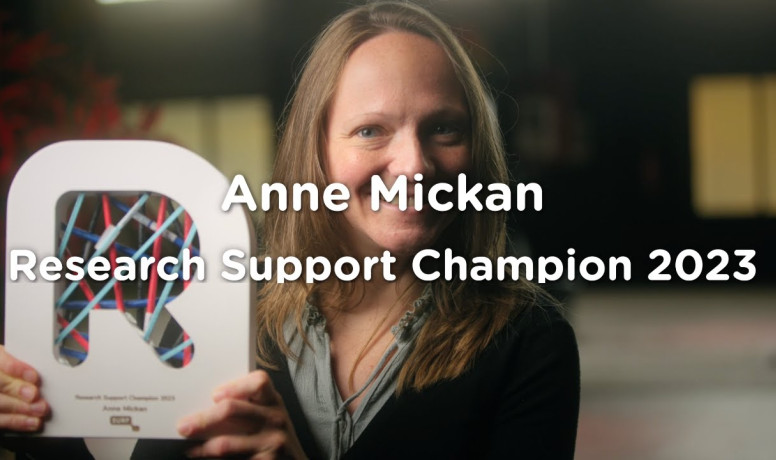
Anne is an exceptional research software engineer, with a great sense of responsibility. She responds quickly to questions and always looks for the best solution. She is a team player and knows how to connect well with Radboudumc researchers. She shows researchers how they can best use software to do their research.
Driving force behind grand-challenge.org
Anne is also a driving force behind grand-challenge.org. This is a platform on which machine learning-based solutions are developed for challenges in the field of biomedical imaging. Researchers all over the world use grand-challenge.org. This platform brings together all information around challenges in the field of biomedical image analysis in one place.
Anne helps users formulate challenges and share them on the platform. Furthermore, she added more than 100 new features to the platform, including features for two-factor authentication, human correction of AI results and many UX improvements.
What does the jury say about Anne?
It is impressive to see that Anne solves so many technical problems of researchers. As far as we are concerned, that is the essence of support, and her way of working thus fits the needs of researchers perfectly.
In addition, Anne's versatility as a research support engineer stands out. With a great sense of communication, she helps researchers, but she also makes an important technical and substantive contribution to the grand-challenge.org platform. With her contribution to this platform, she has a substantial share in developing a standard for machine learning solutions in biomedical imaging for researchers around the world.
How does Anne hope to inspire others?

"I worked as a scientist myself for a number of years, so I know how to put myself in the position of researchers and also know how important it is to do so. You have to be able to listen carefully to the researcher's needs to ultimately reach an appropriate solution so that they can conduct their research efficiently and within FAIR principles.
My tip: be flexible and think creatively. The possibilities within the existing research infrastructure are often limited, but there is always a solution for the researcher, and if you think along creatively and communicate openly, you will certainly be able to find this as a research supporter."