
Open Education API
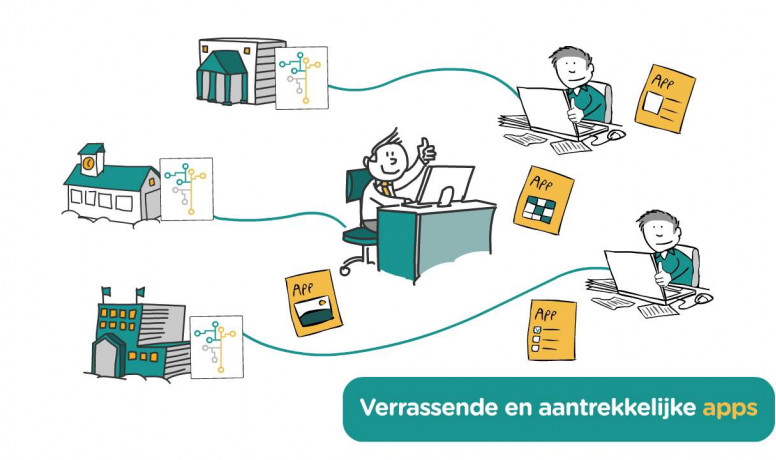
The Open Education API is an open standard for sharing educational data. An API (Application Programming Interface) is a set of definitions allowing software programs to communicate with one another. Using the API, education institutions make useful information available through apps, such as grades or timetable information, for example.

Discover API in the video below. You may have to accept cookies from YouTube to watch this video.
API: indispensable part of integration infrastructure
Increasing numbers of higher education institutions are working on a flexible and personalised learning environment: it is modular in design and made up of a variety of applications from inside and outside the institution. The integration infrastructure is responsible for exchanging data and functionality between these individual applications. And APIs are the interfaces between different software applications and are thus an indispensable part of such integration infrastructure. In this way, education institutions are able to make useful information available through apps, for example: from grades to study credits, from schedules to free workstations.
Continued development of the Open Education API
SURFnet is working on a standard API in collaboration with a number of higher education institutions. This Open Education API makes it easier to develop services based on educational data, which is available within the institution. SURF's Education Product Management team is contributing to the continued development and is promoting the use of this standard. We are exploring the opportunities for SURFnet to provide services in this area. And we are investigating to what extent it is possible to standardise the data in order to also make the data available for other purposes, for example for web applications or mobile apps, which combine or present the information in a new way.
Practical examples
The University of Amsterdam (UvA) and Zuyd University of Applied Sciences are using the API in everyday educational practice. The MyUvA student app by the UvA combines data from the electronic learning environment, the student information system, the timetable system and the UvA website. The Open Education API makes this data available in an easy-to-manage way. When developing a new intranet, Zuyd University of Applied Sciences opted in favour of the Open Education API as a starting point for the underlying source systems.
Community contribution
SURFnet is working on the continued development of the Open Education API together with individual higher education institutions. We encourage participating institutions to make educational data accessible using the standard Open Education API so that application developers are able to develop relevant apps. Are you willing to consider collaborating on the Open Education API? If so, you can register to join the working group by e-mailing info@openonderwijsapi.nl.
More information
- For more information, visit the Open Education API website.

OOAPI steering group
The steering group is the OOAPI's decision-making body, in which the education sector is in charge of the further development and future of the OOAPI standard. The three education sectors – vocational education, higher professional education and university education – each have their own representation in the steering group, alongside the chair of the OOAPI technical working group. The steering group consists of:
- vocational education: Gertjan Flinterman (Deltion College)
- HBO: Froukje Meirink (NHL Stenden University of Applied Sciences)
- WO: Jan-Willem Brock (Leiden University), chair of the steering group
- Chair of the OOAPI technical working group: Patrick van der Veer (SURF)
In addition to these four permanent national seats in the steering group, there is still room available for the representation of European public educational institutions.
OOAPI technical working group
The technical working group is the implementing organisation for the standard. Its technically knowledgeable specialists work on the further development and modification of the OOAPI. The technical working group consists of members from educational institutions, suppliers and SURF. A thorough technical background in the OOAPI standard is a prerequisite for participation in the technical working group. The technical working group develops new functionality itself or oversees the development of modifications and extensions.
OOAPI community
The OOAPI community consists of anyone who is interested in OOAPI, wants to stay informed and/or wants to be involved in its further development. Meetings are organised within the community to discuss developments in OOAPI and to exchange ideas and experiences with other educational institutions. The community can also provide input in the area of wishes and requirements with regard to the OOAPI standard. These wishes and requirements can lead to a new proposal for changes to the OOAPI.
OOAPI project groups
Project groups can be set up for the maintenance or further development of specific uses of the OOAPI. These are groups that work on a specific part of the OOAPI under the umbrella of the technical working group and, in close collaboration with the technical working group, safeguard the functioning and future of the standard.
About the name OEAPI
The OEAPI originated in the Netherlands under the name Open Onderwijs API (OOAPI). It is now used on an international scale. This is a significant development, as it offers opportunities for collaboration based on a single, uniform standard. Not only within the Netherlands, but also with international partners.
Our members’ educational sphere has long since extended beyond the Dutch border and is helping to shape the European ambitions for the European Education Area (EEA). Students take courses at partner institutions abroad and expect processes such as orientation, logging in, enrolment and the transfer of credentials to work seamlessly. This is precisely why it is important that Dutch systems align well with what is required in Europe and beyond. By making the standard more internationally focused, we can prevent fragmentation and isolation within the Netherlands whilst simultaneously strengthening interoperability with international partners.
To better support this international alignment, it has been decided to switch to an English-language name for the standard. From now on, the OOAPI will be referred to as OEAPI (Open Education API).
Although the name is changing, the standard remains the same in substance—only the name now better aligns with international usage.